Free backup utility

Mac Backup Guru

Free backup software for macOS: incremental snapshots, direct clones, and scheduled backups — no daemons running when it isn’t backing up, no subscription.

  • Verified APFS and HFS+ clones of your apps, settings, and data
  • Incremental snapshots with smart pruning to save space
  • Scheduled backups that wait for your disk and notify you of the result

Free · macOS 15 (Sequoia) or later · Universal binary for Apple silicon and Intel

Why people rely on Mac Backup Guru

Verified clones

Restores the first time

The app double-checks file integrity after every copy, so lab Macs and production workstations restore without drama.

Incremental snapshots

Weeks of history, minimal space

Hard-links reuse unchanged files, letting you keep dozens of restore points on a single SSD while still browsing them like full clones.

Scheduled backups

Set it and forget it

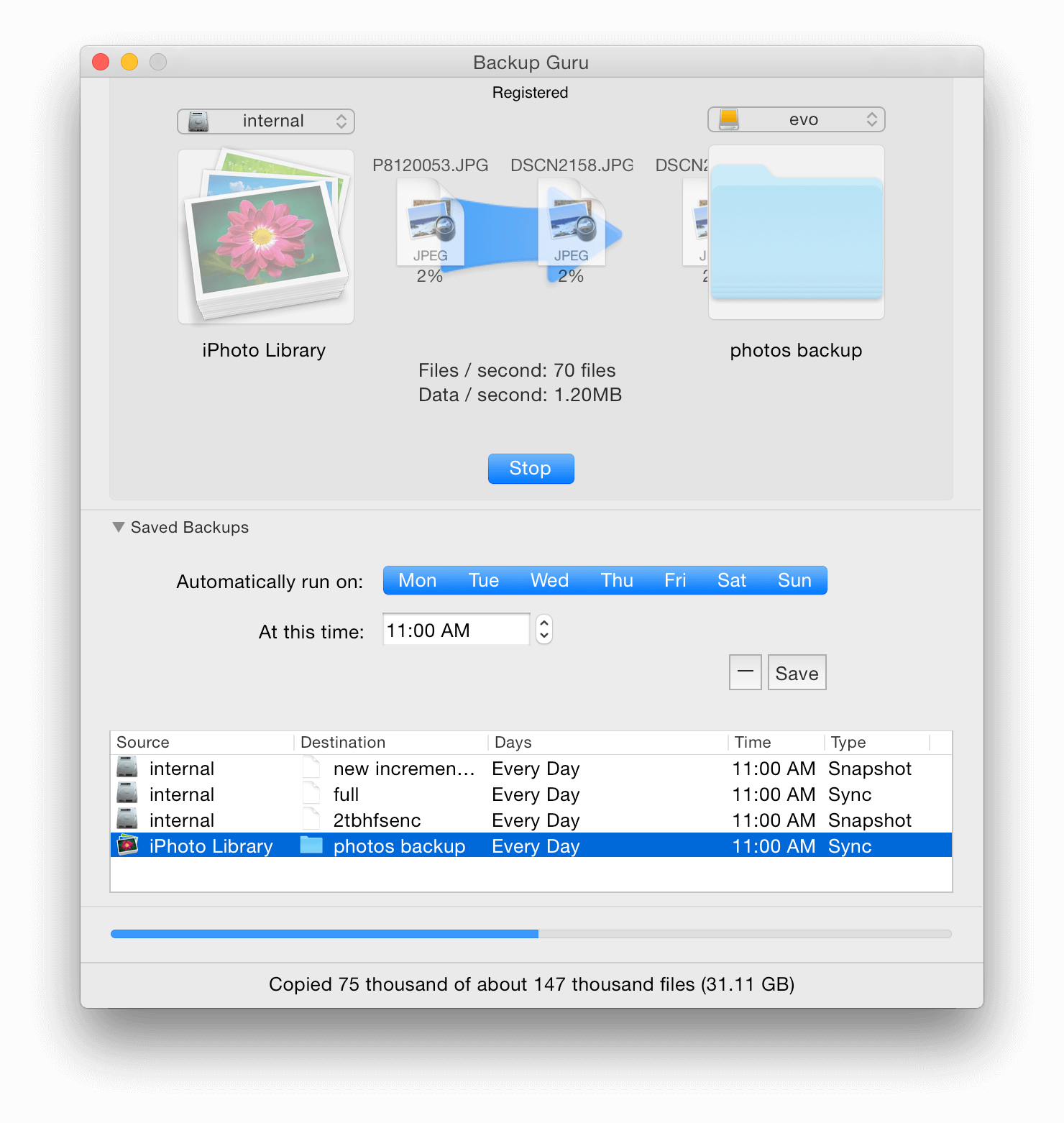
Schedule a backup and walk away. If the destination disk isn’t connected, the job waits and starts the moment you plug it in—then a notification reports the result.

What’s new in version 7.2.0

Released 30 July 2026. Mac Backup Guru is actively developed; this is the current release.

  • Now a universal app: runs natively on Apple silicon and Intel Macs.
  • New Full Disk Access setup: the app detects missing or stale permission, walks you through granting it, and continues automatically once granted.
  • Scheduled backups no longer launch the app at login when the backup disk isn’t connected — the backup starts as soon as the disk is plugged in.
  • Clearer backup-failure messages, including detection of network drives (NAS) that drop out mid-backup.
  • Notifications now report the result of scheduled and unattended backups.
  • Extra data-safety checks on the copy path and more robust failure handling.
  • Requires macOS 15 (Sequoia) or later.

Bootable backups on modern macOS

Bootable copies are still possible, but Apple’s Signed System Volume changed the rules: cloning alone no longer produces a bootable disk, because Apple only trusts a system volume written by its own installer. The dependable route is to install macOS onto the external drive first (Install Disk Creator helps here), then bring your apps, settings, and documents across with Mac Backup Guru. Follow the step-by-step bootable backup guide — last reviewed June 2026.
Inside Mac Backup Guru

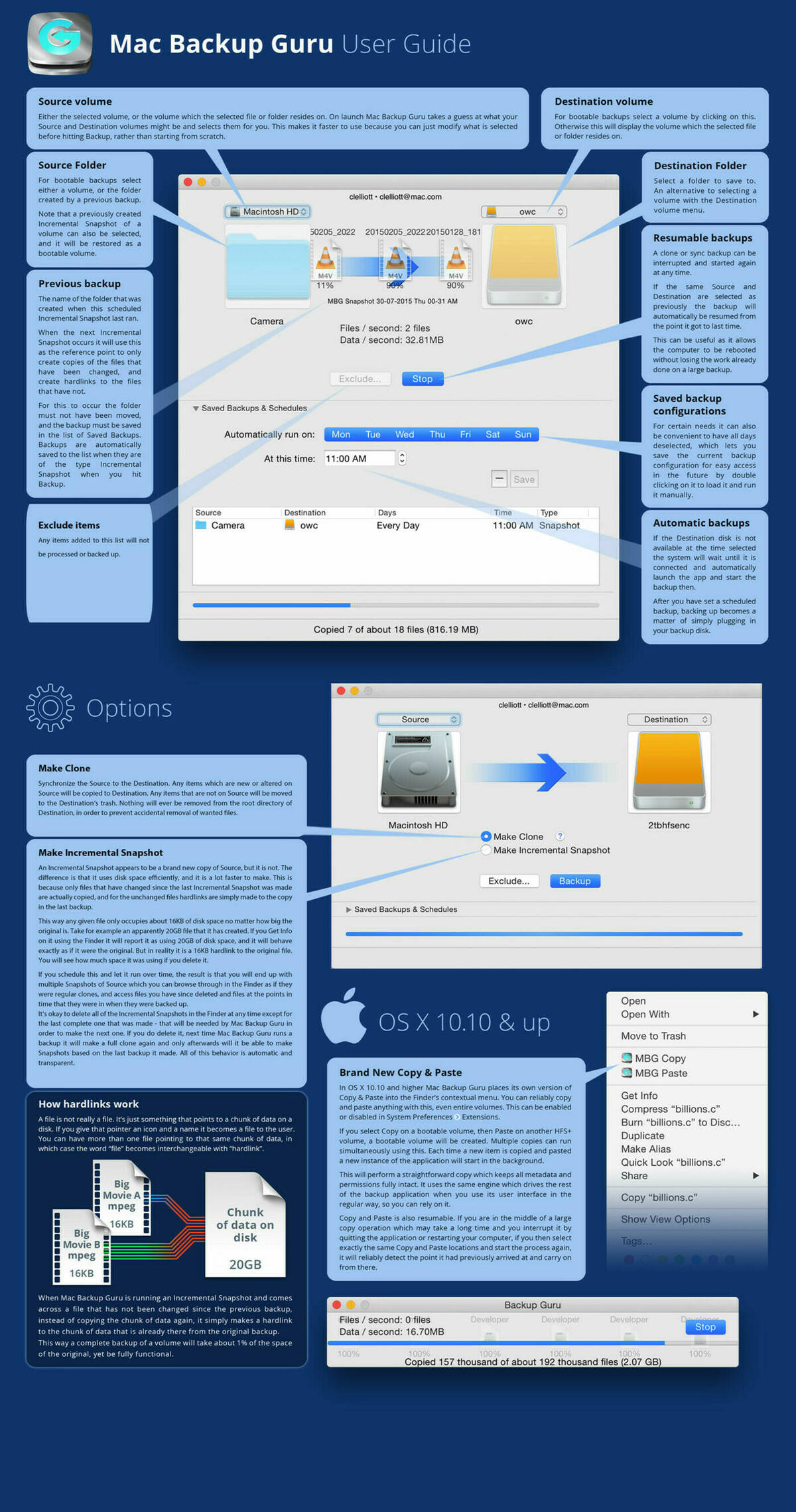
Mac Backup Guru main window showing clone and snapshot options
Choose Direct Clone, Synchronisation, or Snapshots—all in one view.

Mac Backup Guru creates clones and incremental snapshots without background daemons. If you want the original guides you wrote, they’re still available: the quick visual guide and the full product manual. The latest build is always MacBackupGuru.zip.

Direct cloning

Create a byte-for-byte copy of any volume. The engine handles petabyte-scale data, complex ACLs, and system files that Finder copies usually miss. For a copy you can boot from on modern macOS, follow the installer-first workflow.

Synchronisation

Update an existing clone in a fraction of the time. Only the files that changed are written, and anything else on the destination disk stays untouched.

Incremental snapshots

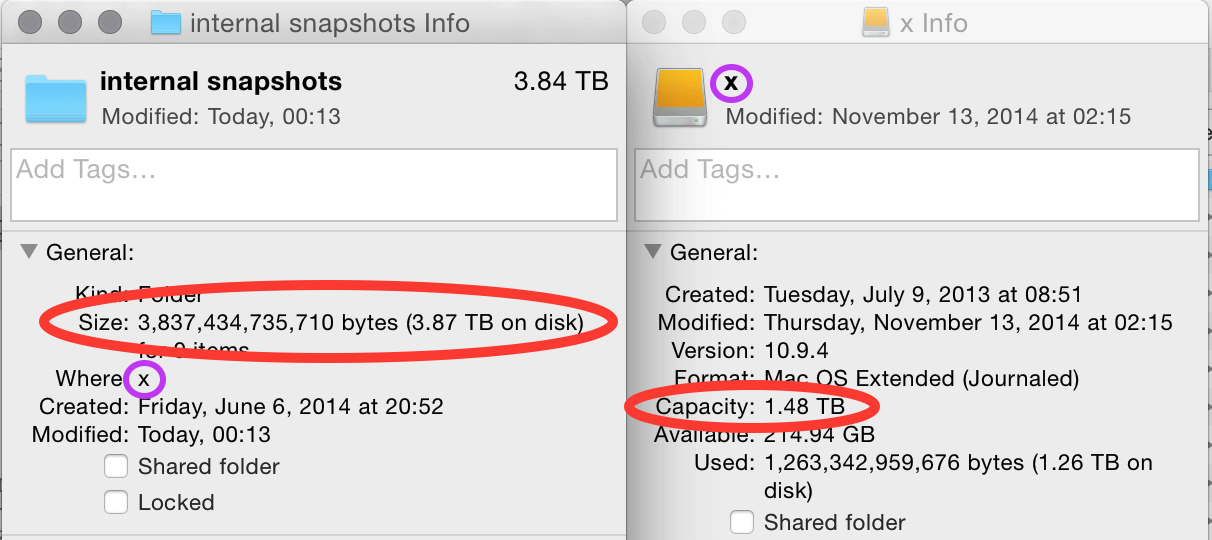
Snapshots behave like full clones but reuse unchanged files with hard links. A 500 GB source can keep months of restore points on a 2 TB drive while consuming just a few gigabytes per run.

Chart demonstrating how incremental snapshots reuse storage
Snapshots reuse data from the previous run, so dozens of restore points fit on one backup drive.

Frequently asked

Is Mac Backup Guru really free?
Yes. The full app is free — every feature, no trial period, no subscription, and no locked “pro” tier.
Can I back up while I’m using my Mac?
Yes. Clones and snapshots run in the background while you keep working.
Will scheduled jobs run if the app is closed?
Yes. Mac Backup Guru launches in the background to honour the schedule.
What happens if the destination drive is offline?
The job runs automatically the moment the drive reconnects, and you’ll see a notification that a backup is waiting.
Can I back up to a NAS or other network drive?
Yes, though a directly attached SSD is the more dependable home for your primary backup. Network drives can drop out mid-backup; when that happens, Mac Backup Guru detects it and tells you exactly what failed rather than reporting a bad backup as successful.
How do I restore a backup?
Clone from the backup back to your working drive. Pick any clone or snapshot as the source and write it to the volume you want to restore.
How is this different from Time Machine?
You choose what to back up, where it lives, and how long snapshots stick around. You can browse backups in Finder, delete what you no longer need, and the run finishes dramatically faster on large datasets.

Tip: Only the newest completed snapshot has to stick around. Prune older snapshots manually or set the retention count so Mac Backup Guru deletes the oldest copies automatically after each run.

Download & uninstall

  • Download: MacBackupGuru.zip
  • Price: Free — the full app, no subscription, no trial.
  • Requirements: macOS 15 (Sequoia) or newer · Universal for Apple silicon and Intel
  • Uninstall: Turn off any scheduled backups in the app, then drag Mac Backup Guru from Applications to the Trash.

Questions about your backup workflow?

Share your setup, source drives, and any gotchas. We’ll help you tune the schedule, snapshot retention, or cloning strategy.
Contact support Follow on X @BenedictSlaney Want to chip in? Bitcoin tips: 1MbwUFSbQvMrd826DTpup7PpTTNrrJjaJ8